NEO Planner, Planning the observation night for comets, NEO and NEOCP objects
IAU codes: B82 Maidbronn (retired) and K87 Dettelbach Vineyard Observatory
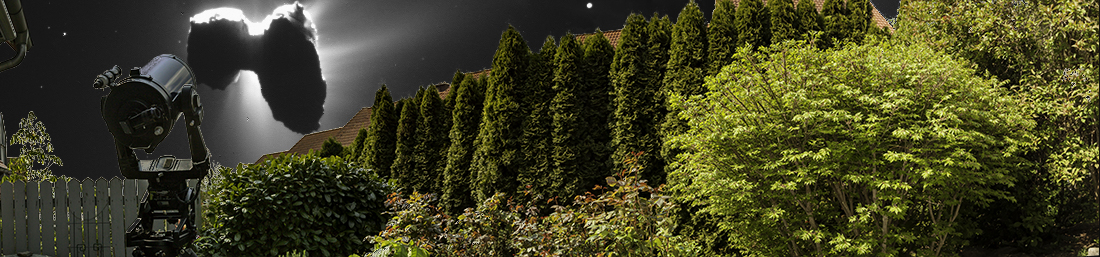
K87 Dettelbach Vineyard Observatory with old equipment
(C) Copyright: Photo montage performed by Bernhard Häusler, Germany
Credit of the comet image of 67P/Churyumov-Gerasimenko: ESA/Rosetta/NAVCAM (C) CC BY-SA IGO 3.0
and ESA/Rosetta/MPS for OSIRIS Team MPS/UPD/LAM/IAA/SSO/INTA/UPM/DASP/IDA
Don't waste time planning the night session and focus on the evaluation.
You proudly call an IAU Observatory Code your own and have perhaps long since lost
the motivation for the fascinating observation and tracking of NEO and comets?
Or are you observing objects in the solar system with a remote telescope?
Then this page has the solution for your enormous motivation boost
for active amateur work and the use of your equipment for research.
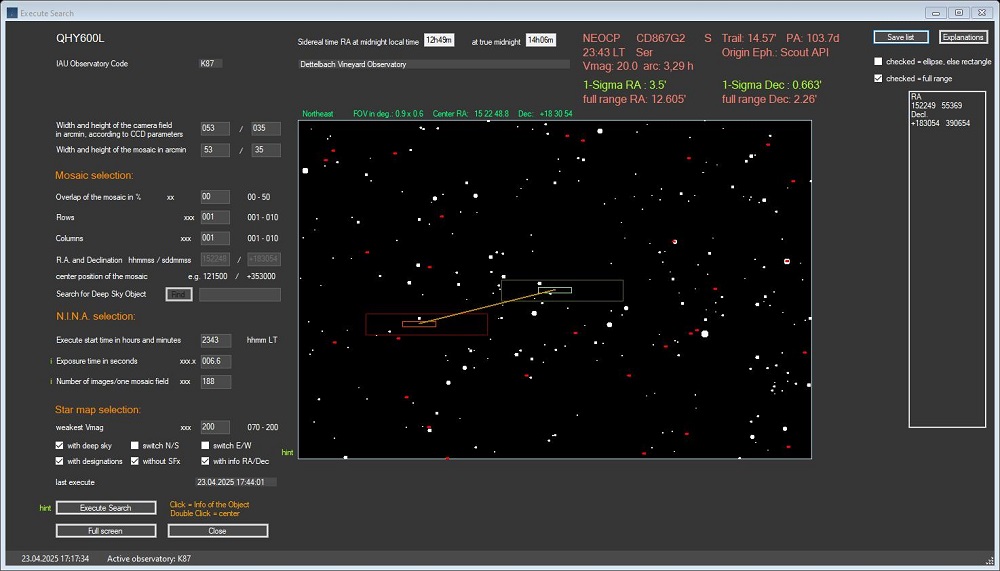
The following image shows the Execute Search screen triggered by the "S" function in the Revise Planning screen.
The planned path of a NEOCP object including its 1-sigma and full range deviations is shown as squares determined from
Scout API data.
Some basics of NEO Planner and the mathematical highlight of my life
The difference between two integer magnitudes of Stars means a reduction or increase in brightness of 2.512 times as is well known.
The formula for exponential growth or decay is then 2.512difference.
Where the difference is the positive or negative difference between the determined sky background of any observatory and my reference value of K87 Dettelbach Vineyard Observatory.
It took me three desperate days to figure out this formula through my own thoughts. After finding the right formula, I was rewarded with ecstatic shouts of "Eureka!"
and was able to begin programming NEO Planner.
Details on the calculation methods for the necessary number of images of objects in the solar system for each observatory in the world can be found
here.
Amateur astronomical background
Interest in the night sky since the age of four. During my youth, I drew the moon and constellations, took my first photographs,
and made my first visual observations with a small refractor telescope.
In 1993, I acquired a 12" SCT and CCD camera, photographing deep-sky objects, comets, and, more rarely, NEOs.
I discovered two Main Belt asteroids:
(410928) Maidbronn
and (668527) Christophgerhard
in 2009 and 2012, respectively.
In 2017, I acquired a new 12" SCT and a new CMOS camera. Since then I programmed an automated comet and NEO observation system for my own use.
In 2020, I began programming NEO Planner for the automated observation of solar system objects for observatories worldwide,
in the workflow with N.I.N.A. by Stefan Berg and
Tycho Tracker by Daniel Parrott or
Astrometrica by Herbert Raab.
Since 2015, I have given television and radio interviews about my discovery of asteroid Maidbronn from my balcony,
which was also reported worldwide in newspapers or online news initiated by the German Press Agency (DPA).
I also write articles about my observations and NEO Planner for astronomy magazines and give presentations about NEO Planner in Germany and Austria.
Observers of the solar system exchange their experiences in the German-language Signal group or the English-language NEO Planner Discord channel.
In 2026, the asteroid (748569) Bernhardhäusler
was named after me (discoverer and namesake: Jost Jahn).
go to top
These pages are private, ad-free, and generate no revenue. May I use Google Tags for my own statistical purposes to improve the NEO Planner pages?
 Click here for: Introduction to NEO Planner